Latest




OPENING HOURS
Mon-Thursday Kl. 09:00-18:00
Friday Kl. 09:00-17:00
Saturday Kl. 10:00-14:00
Sunday - Closed
Flag rules Aboard
How to flag on a boat
Country Flag
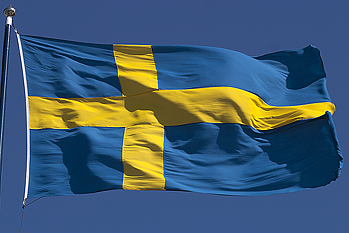
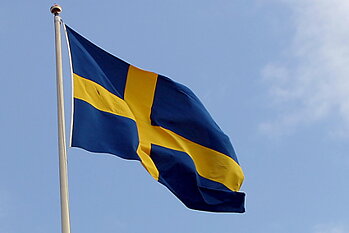
The Swedish flag on a boat indicates that the owner is Swedish. When a boat is on its way, national flag will be taken at all times of the day. The flag shall always be conducted in the following cases:- When entering or leaving port,
- at the coast,
- within view of warships, pilot or coast guard station,
- on the open sea, when the boat is within sight of another ship,
- in foreign waters.
When the boat is for anchor or when it is moored with crew on board, there are two different schools with regard to flagging (the flags up times). One (see below) is the one who follows most when they are at sea. It has, however, started to come as a small group of followers as the second and think it is the right choice.
1, The accepted definition also applies to flagging on land, The time between March 1 - October 31 is raised the flag at. 08.00 and during the rest of the year at. 09:00. It is hauled down by the sun's decline, however, no later than noon. 21:00. I am the guest harbors it is often someone who can or can hear from playing a tappto on the trumpet when it is time to take down the flag.
2, The controversial definition of the flag's uptime at sea is that the flag is sitting up during the day all hours when the boat is manned on board (is manned), in the same way as it is in civilian shipping where the ships for the flag 24/7 both at sea and at kaj.
The destination flag
When traveling in foreign waters, the host country's national flag shall be run as a destination flag, it is also called a courtesy flag. It is then moved under starboard water spreader or on the motor boat mast top. Only one destination flag at a time is hoisted. When you move from one country to another's flag at the border. If you so wish, the destination flag can be hoisted the sailing day in the last port of the home country and hauled down in the evening the day when you have returned to the first port in the home country. When the destination flag is moved, the club stand and other recognition flags are normally hoisted under starboard sprinklers instead of the port spreader. Destination flag is always carried alone. Destination flags are hoisted and hauled at the same time as their own national flag. Here you will find destination flags.
Club Standards
The club stand is placed under starboard sprinkler. On a boat without a mast, the standard is moved to the mast in the stern. The standard can be taken at all times of the day.
If a boat is registered in several associations, the same sprinkler flags are placed and standardized in the following order: Royal club, national association, regional association and local club. In the club's own port, however, the club standard should be brought alone or at the top of several association flags regardless of the above.
Dressing a ship with nautical flags
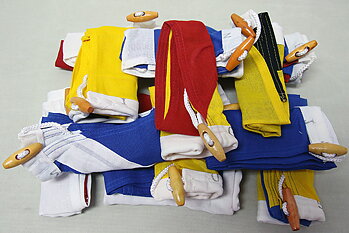
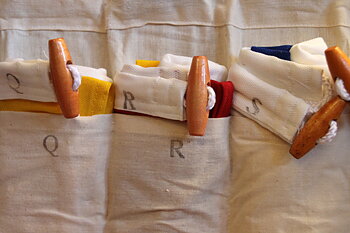
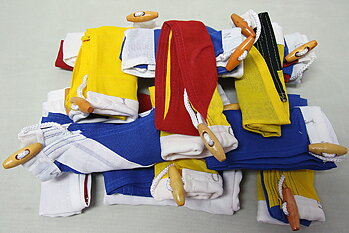
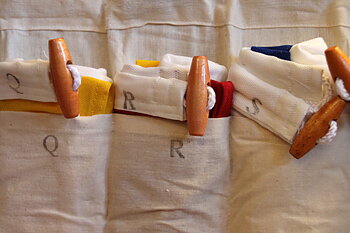
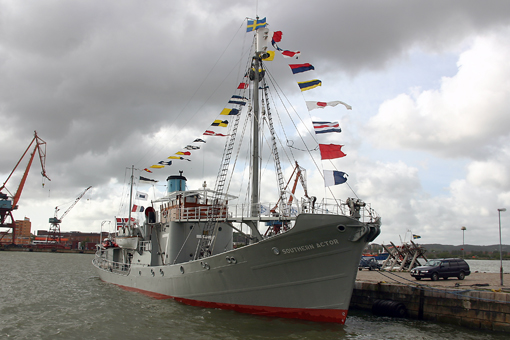
Dressing a ship takes place at celebrations, parties and the like, when the boat is at anchor or moored, and can also be taken at the incoming or leaving port, on festive occasions. Big flagging is hoisted and hauled simultaneously with the national flag. At large flagging, the boat is dressed from bow to stern over the peaks with signal flags. These are hoisted in the following order from the stiff if you have an international signal set: the flags Code, A, B, the numeric dot 1, the flags C, D, the numeric dot 2, etc. On the other hand, if you have a Swedish signal set where Å, Ä and Ö are also included, then you have the following order of the flags: Code, A, B, C, numeric dot 1, flags D, E, F numeric dot 2, etc. Here we have nautical flag sets.
Back