




OPENING HOURS
Mon-Thursday Kl. 09:00-18:00
Friday Kl. 09:00-17:00
Saturday Kl. 10:00-14:00
Sunday - Closed
History of the Flag
Three-tailed Swedish flag 1626
Derived from Gustav II Adolf's time, and the first drawing on it is from 1626. The wooden tongue flag may only be used by H.M. The king and other members of the royal family, as well as as the flag of the army of the armed forces. Other things can be said about the arrival of the flag.
The Swedish Flag of Sweden is a three-tongued Swedish flag that the Swedish Armed Forces uses. From the beginning, the flag being carried on warships. The blue and yellow in the flag can be led back to the folk song time. In the late 16th century, both striped and cross-painted blue-yellow flags were used.
The cross designation that eventually became the most common can be inspired by the then "arch enemy" Denmark's Dannebrogen. During this time both cross-cut and two-tongue flags were used, but during Gustav II Adolf's time the wooden tongue was introduced. The first regulations on the flag were issued in 1663. It emerged from these that warships and fortresses, as well as the Swedish state, would carry a three-flagged flag - a flag of war. Other vessels were not allowed to use this, so the cross-hatch eventually returned as a merchant vessel. As an original example, the Swedish East India Company was given the privilege of having on its ships the flag of the war while the naval fleet / archipelago fleet had to use a whole blue flag. The use of the flag had purely practical purposes as a national designation of the oceans and as a sense image of the Swedish state power. In the event of war (eg "elevated readiness"), the flag of war must be hoisted all day. The flag used by the head of state is the flag of the war coated with the Great Rifle. Source: Wikipedia
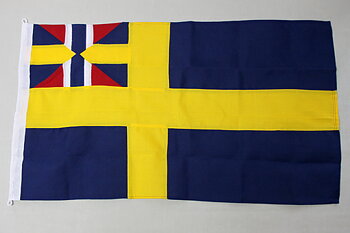
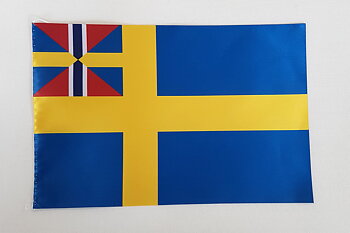
Swedish Union Flag 1815-1844
Union flag with the so-called The "Salad Salad" in the upper corner was introduced in both Swedish and Norwegian flags in 1844 and was used until the Union Revolution in 1905. On March 7, 1815, a common flag of Sweden and Norway was established, which was quite similar to the Swedish flag used to date, except that the upper corner closest to the bar was red with a diagonal white cross. As a trade flag, at the beginning of the Union period in Norway, the Danish flag with the Norwegian coat of arms was carried in the upper corner closest to the bar. However, by royal decree on July 17, 1821, it was determined that "as the unified Swedish and Norwegian flag (as well as the flag of the war, but the transverse) is of all maritime history known and recognized", so only the Swedish and Norwegian merchant ships who brought this flag could beyond cape Finisterre count on the protection of Swedish warships and the assistance of the consulates of the united kingdoms. With regard to said cape, the merchant ships were allowed to carry either the "united" flag or "each national special flag", that is to say Swedish vessels the completely blue-yellow and Norwegian ships "the flag that we specifically established for Norway in graces".
Sweden's trade flag with union mark 1844-1905
The flags of Sweden and Norway after the Union mark was removed from the Norwegian flag. Circular from Kongl. Ministry of Foreign Affairs October 18, 1899. Note the blue color and the proportions of the Union mark in the Swedish flag. This relationship existed until 1844, when by royal letter June 20 both countries received their special war flags and trade flags, which in the top inner field were provided with a Union sign formed by a symmetrical compilation of the colors belonging to both kingdoms - the so-called " herring salad ". The Union sign was removed from the Norwegian flag in 1899 and from the Swedish flag in 1905, after the union dissolution. According to time after other regulations issued, the flag of war would also be carried on certain ships and buildings, belonging to the pilot, customs and postal services, but with the change that in the middle of the yellow cross there would be a white field, on which in gold or bronze color was placed : for the pilot plant (from 1881) an anchor with star over, for the customs authority (from 1844) a T with royal crown and for the post office (from 1844) a posthorn with royal crown. Regarding individual persons belonging to ships, which have been contracted to carry mail on behalf of the post office, the royal letter decided on 1 August 1838 that they had to bring Swedish flag with two tongues (a so-called split flag, without yellow tongue).
Union resolution
Already six years before the union dissolution (royal letter October 11, 1899), it was decided in Norway to remove the Union sign from the state flag and the trade flag, which eventually became the national flag (see the flag question). In Sweden, this only disappeared after the dissolution of the union, since a royal decree of 27 October 1905 decided that from 1 November of the same year, a blue field would be introduced in both the trade and the war flag in the place of the Union sign. The latter day at. 9 in the morning, the new flag was hoisted under cannon salads at fortresses and castles. At the same time, it was hoisted on a large number of individual ships and buildings, especially in Stockholm, while it was called from the church towers and steam escapes were heard from several steamers on the Strömmen and from a number of factories.In the privileges of October 31, 1786, the West Indies Company was granted the right to bring the flag of the Crown into the West Indian waters, when there was no warship there. Elsewhere it was February 27, 1832, which in Sweden for the first time was granted permission to carry the three-tongue flag on individual craft, in that the Swedish sailing society then was granted permission to bring the war flags with a white box in the yellow cross and in the white box a gilded O with princely crown, which later in 1878 was changed to royal. On June 7, 1893, the Gothenburg seal society was also allowed to bring the Swedish flag with a white box in the yellow cross and in the white box the letters G S S, gilded and with a gilded five-pointed star over. However, the right of these sailing societies to carry the three-tongue flag lapsed through the flag layers.
On May 7, 1897, several new regulations regarding the Swedish flag's conduct on state ships and buildings had been issued, whereby among other things It was stated that there would be another flag of the state, besides the flag of the war, without a yellow tongue, which would be hoisted on such state ships and buildings that should not carry a flag of war. These provisions were repealed by the "Law on the Flag of the Kingdom", which after the hearing of the Riksdag was issued on June 22, 1906. This law, which contained detailed rules on the shape and color of the flag, etc., did not, of course, contain any expression of "the national flag of Sweden", but stated that The Swedish flag would be "blue with a yellow cross". The cross would divide the flag into four right-angled, equally high fields. The color of the flag's sidebar would be "light blue" and on the cross "golden yellow". The flag would be transverse, except when used as a flag of the war, in which case it would be triangular. War flags would be brought on the fleet's ships, boats and buildings; on the fortresses of the kingdom; at the barracks buildings, camps and practice places of the gentleman, also on the mooring of ships and boats, when carried by military commanders; and on a building, which was entirely granted to staff, troop or military education school.
The king and, with his permission, a member of the royal house, had to carry a three-tailed flag, with or without the kingdom's arms on a white field in the middle of the cross, as well as use such signs in the cross-border flag.
Any provisions notified by the King could, in a three-tiered flag, be marked with a command, placed in the upper inner field. Otherwise, the flag was not to be marked with letters, letters or other characters.
Anyone who unlawfully used a three-flagged flag or flag with unauthorized marks, etc., or held a flag for sale, which differed from what was prescribed or which did not keep the determined dimensions, would be fined from SEK 10 to SEK 100.
The flag team came into force on July 1, 1906. However, "customary flags" were brought to the end of 1908. Source: Wikipedia
Västgötalandsflag 1992
The Västgötaland flag is based on the götaland flag and to this has been added a distinctive white inner cross.
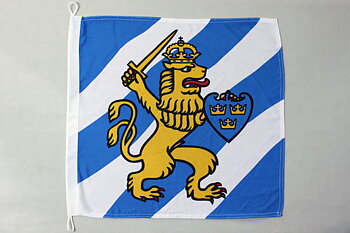
Göteborgsgös (Gothenburg city weapon)
The first time the Gothenburg weapons were used was in 1607. The weapon's content is unique, because it is formed by the two great elements of the Great Rifle "Göta Lejon" and "Svea Rikets" shield.
Back